What Is the Opening Range Breakout (ORB) Strategy?
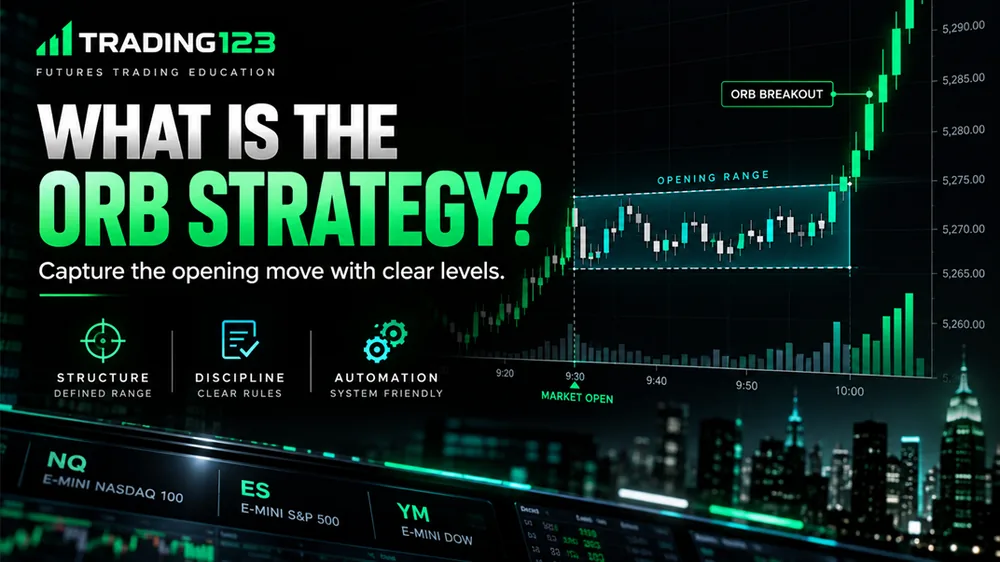
The market open is one of the most active — and most tradable — moments of the session. Volume surges, spreads widen, and the day's early direction often gets decided in the first few minutes. The Opening Range Breakout (ORB) strategy is a simple, rules-based way to trade that energy without guessing.
What is the "opening range"?
The opening range is simply the high and the low that price makes during a fixed window right after the open — commonly the first 5, 15, or 30 minutes. Those two levels box in the market's initial battle between buyers and sellers. Until price leaves that box, the market is undecided. When it breaks out, it's often telling you which side won.
How the breakout is traded
The core idea is straightforward:
- Break above the range high → potential long, betting buyers have taken control.
- Break below the range low → potential short, betting sellers have taken control.
- Stop typically goes on the opposite side of the range (or a fraction of it).
- Target is often a multiple of the range's height, or a prior support/resistance level.
On index futures like the ES (E-mini S&P 500) and NQ (E-mini Nasdaq), the opening range tends to be clean and liquid, which is why so many futures traders build their morning routine around it.
Why it works
The open concentrates order flow. Overnight positions get adjusted, economic data lands, and institutions execute size. That creates volatility and, frequently, a decisive push once price commits to a direction. A breakout of the opening range is one objective way to define "the market has committed."
There's also a statistical tendency behind it: across large samples of stocks and futures, the session's open tends to land near the eventual high or low of the day far more often than random chance would suggest. Put simply, the open is rarely the middle of the day — price usually travels away from it. A breakout of the opening range is one objective way to trade in the direction of that travel, rather than guessing at the top or bottom.
Choosing your opening-range window
There's no single "correct" opening range — it depends on your timeframe and how much you've tested. When the strategy first became popular decades ago, traders often used the first hour of the session as the range. As data feeds got faster and traders moved to shorter charts, many narrowed it to the first 30, 15, or even 5 minutes.
- 5-minute range — the fastest signals and the most of them, but more noise; popular with scalpers.
- 15-minute range — a common middle ground on ES and NQ: enough structure to matter, early enough to catch the move.
- 30-minute or first hour — fewer, higher-conviction signals, favored by intraday swing traders.
Pick one window, define it precisely, and stay consistent. The edge comes from repeating the same rules — not from switching timeframes after a losing trade.
Filters that improve it
A naked breakout can get chopped up on quiet days. Common filters traders add:
- Volume confirmation — a breakout on rising volume is more convincing than one on thin volume.
- A time window — only take signals within a defined period after the open, then stand aside.
- Trend alignment — favoring breakouts in the direction of the higher-timeframe trend.
- A minimum range size — skipping days where the range is so tight that a break means little.
Risk management
ORB lives or dies on discipline. Define the stop and target before you enter, size the position so a single loss is small relative to your account (our free futures position size calculator does the math), and accept that not every day produces a clean breakout. A repeatable process beats a perfect prediction.
Common mistakes
- Chasing — entering well after the break instead of at the level, giving up a poor risk-to-reward.
- No confirmation — taking every poke through the range, including obvious fake-outs.
- Ignoring the calendar — trading straight into a major news release.
- Over-trading — forcing setups after the prime window has passed.
A worked example on the NQ
Here's how a 15-minute ORB might play out on the E-mini Nasdaq (NQ). Suppose the first 15 minutes after the open print a high of 20,140 and a low of 20,110 — a 30-point opening range.
- Entry: price breaks and holds above 20,140 on rising volume → go long around 20,141.
- Stop: the opposite side of the range, near 20,110 (about 30 points of risk) — or a tighter fraction of the range if your rules allow.
- Target: a multiple of the range height — e.g. 1× the range (30 points) for a 1:1, or 2× (60 points) for a 2:1 toward the next resistance level.
Had price instead broken below 20,110, the mirror-image short would apply. The exact numbers aren't the point — what matters is that the range hands you a defined entry, a defined stop, and a defined target before you risk a dollar. On the NQ, a 30-point stop is 30 × $20 = $600 per contract (see the futures tick value chart), which is what sets how many contracts fit your account. (Illustration only — not a recommendation or a past result.)
Opening range breakout checklist
- Marked the opening-range high and low for your chosen window (5/15/30-min).
- Waited for a decisive break — not a one-tick poke — ideally on rising volume.
- Checked the higher-timeframe trend and the day's economic calendar.
- Set the stop on the opposite side of the range before entering.
- Defined the target (a range multiple or nearby support/resistance) and the position size.
- Stopped taking new signals once your time window closed.
Automating the ORB
Because the rules are objective, the ORB is a natural fit for automation — the computer can mark the range, watch for the break, and manage entries, stops, and targets without hesitation or emotion. That's exactly what our Opening Range Breakout Strategy for NinjaTrader 8 does: it auto-detects the opening range and trades breakouts, breakdowns, and reversals with built-in risk management.
Frequently asked questions
What is the best opening range timeframe?
There's no universal best — the 5-minute range suits scalpers, the 15-minute is a common balance on ES and NQ, and the 30-minute or first hour gives fewer, higher-conviction signals. Choose one window and test it consistently.
Does the opening range breakout work on futures?
Yes — index futures like the ES and NQ are popular for the ORB because the open is liquid and volatile. The same idea applies to other high-liquidity markets, though the exact settings vary by instrument.
What time is the opening range?
For US index futures, most traders anchor it to the 9:30 a.m. ET cash-session open and measure the range over the first 5, 15, or 30 minutes from there.
Can the opening range breakout be automated?
Yes. Because the rules are fully objective, it's well suited to automation — see our Opening Range Breakout Strategy for NinjaTrader 8, which detects the range and manages entries, stops, and targets for you.
Key takeaways
- The opening range is the high/low of the first 5–30 minutes after the open.
- Trade breaks above/below it, with stops on the opposite side.
- Volume, a time window, and trend alignment filter out weak signals.
- Its objective rules make it well suited to automation.
Want the ORB traded for you?
Our Opening Range Breakout Strategy automates the whole process on NinjaTrader 8 — range detection, entries, stops, and targets — so you can trade the open with discipline instead of emotion.
Get the ORB StrategyEducational disclaimer: This article is for educational purposes only and is not financial advice or a recommendation to trade. Futures trading involves substantial risk of loss and is not suitable for every investor. Past performance is not indicative of future results.